
Gentoo banned AI-written code in April 2024, NetBSD a month later, QEMU in June 2025. I followed every commit since 2018 in those three and in four comparable projects that never banned it (Linux, LLVM, nixpkgs, FreeBSD), and compared newcomers per half-year before and after each ban, relative to the comparison projects (1.0 means a project moved like them). Data as of 2 November 2026.
Gentoo was losing ground against the comparison projects at the same pace two years before its ban (0.61) as after it (0.58). The ban didn't change its course.
QEMU did better after its ban than its own history predicted: from 0.68 to 0.92, with 166 newcomers in the first half of 2026.
NetBSD has between 0 and 4 new names a half-year, too few to read anything into.
On 18 September 2026 QEMU merged a series of 30 commits that each carry the line "Assisted-by: Claude Opus 4.6 (1M context)". Their author wrote that the use "falls within the 'non-creative' use" the project has said is OK. Gentoo had none in more than a quarter of a million commits after its ban; NetBSD had one, carried in with an upstream import.
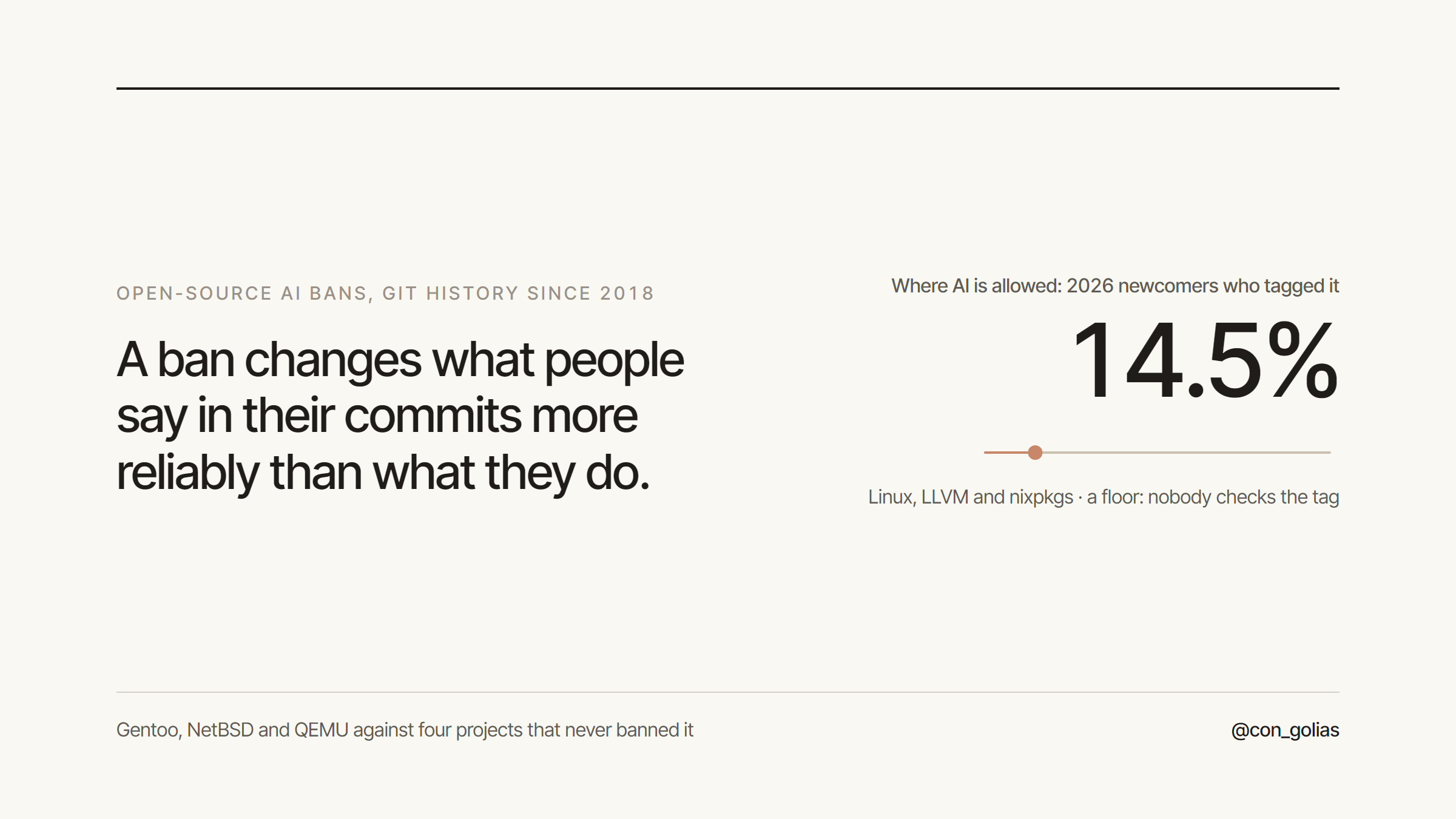
Where AI is allowed, it shows: 14.5% of this year's newcomers to Linux, LLVM and nixpkgs tagged an AI tool on at least one commit. That is a floor, since nobody checks the tag.
What I took from it: a ban changes what people say in their commits more reliably than what they do. If you contribute to a project with one, read it strictly, and if you think your use is the allowed kind, say so in the open.
Full method and data in the X Article: https://x.com/con_golias/status/2117281178868666575