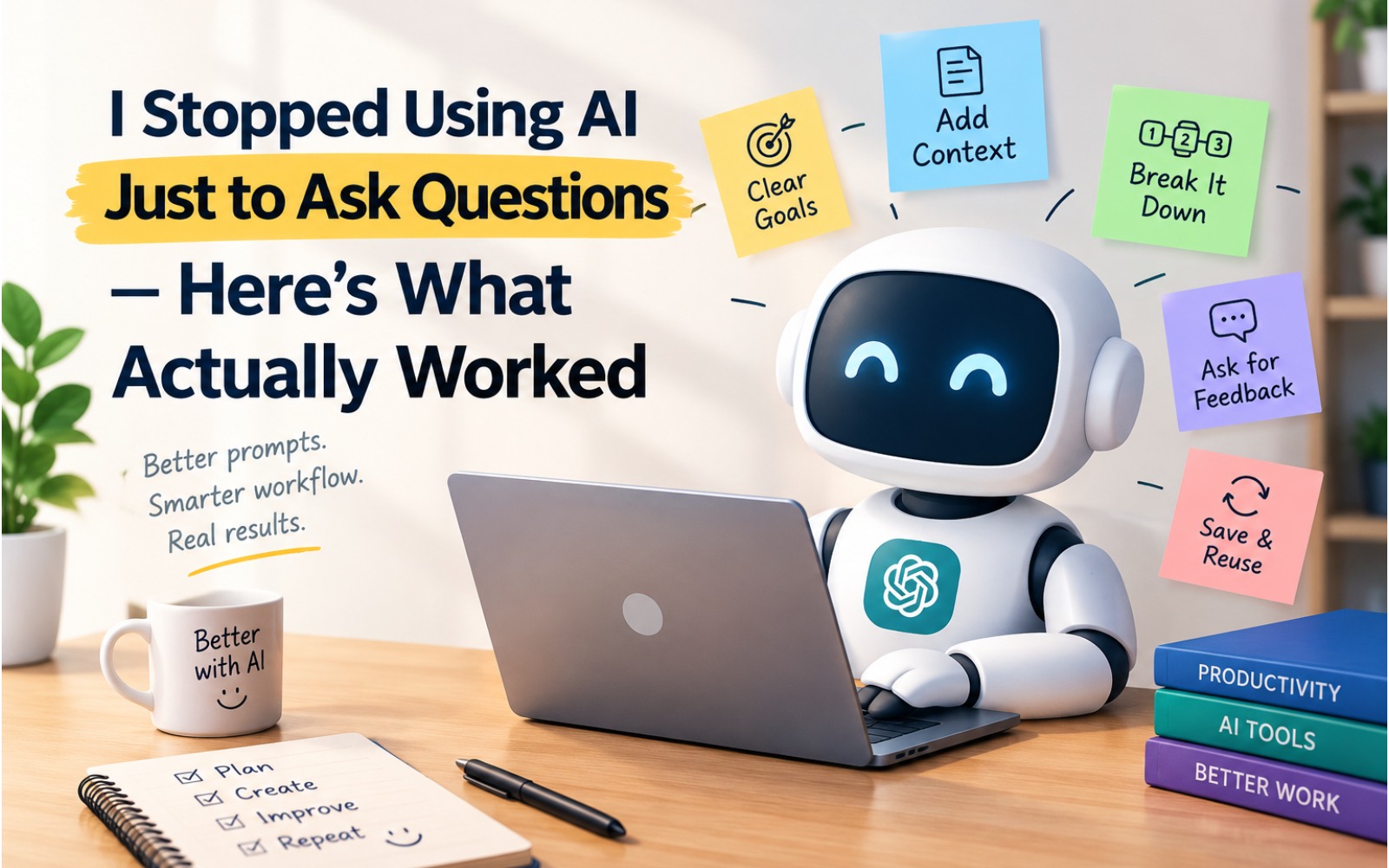

AI became much more useful to me when I stopped treating it like a search engine and started treating it like a work partner.
Instead of asking random questions, I began using it to solve specific problems, improve my workflow, and turn rough ideas into actionable results.
Here are 5 things that made the biggest difference.
1. Give AI a clear goal
Vague prompts usually lead to generic answers.
Instead of saying:
“Help me with my work.”
Try:
“Help me create a simple weekly plan to finish these three tasks. Prioritize them by impact and estimate how much time each will take.”
The clearer the goal, the more useful the response.
2. Provide context before asking for an answer
AI works better when it understands your audience, constraints, and desired outcome.
For example, if you're writing a post, explain who it's for, what you want readers to learn, and what tone you prefer.
A little context can make a big difference.
3. Break large tasks into smaller steps
Rather than asking AI to handle an entire project in one prompt, work through it step by step.
For example:
Brainstorm ideas.
Choose the strongest idea.
Create an outline.
Draft the content.
Review and improve it.
This makes the process easier to control and the final result easier to refine.
4. Ask AI to critique its own output
Don't stop at the first answer.
Try asking:
“What are the three weakest parts of this answer? What assumptions might be wrong, and how would you improve it?”
Then review the suggestions yourself. AI can miss important details, so treat its feedback as a starting point rather than unquestionable truth.
5. Turn useful prompts into repeatable workflows
If a prompt works well, save it.
Create reusable templates for tasks you do regularly, such as writing emails, summarizing documents, planning projects, or generating content ideas.
Over time, you can build a simple workflow instead of starting from scratch every time.
The biggest takeaway
The real value of AI isn't simply getting answers faster. It's reducing friction between having an idea and turning it into something useful.
My practical rule: Be specific about the goal, provide enough context, work in small steps, and always review the result.
AI is most useful when you combine its speed with your own judgment.
What about you?
What's one way you've used AI that genuinely improved your workflow? Share your experience in the comments — I'd love to learn what works for others.