
When I first started building RankQuest, the idea was much broader than it is today.
I wanted to build an all-in-one SEO product.
One place for technical SEO, keyword research, site analysis, content opportunities, competitor research, and all the usual dashboards you would expect from an SEO tool.
At the time, that felt like the right direction.
More features meant more value.
Or at least that’s what I thought.
The problem wasn’t lack of data
Once I started getting RankQuest in front of real users, something became obvious.
Most founders didn’t need another dashboard full of SEO information.
They already had access to plenty of data through tools like Google Search Console, Ahrefs, Semrush, PageSpeed Insights, and dozens of audit tools.
The real problem was what happened after all that data appeared.
You open an SEO tool and suddenly you have:
technical warnings
declining pages
keyword opportunities
content gaps
internal linking issues
pages sitting on page two
performance problems
dozens of things marked as “important”
And then comes the actual question:
Which one should I work on first?
That was the part I became much more interested in.
I started removing instead of adding
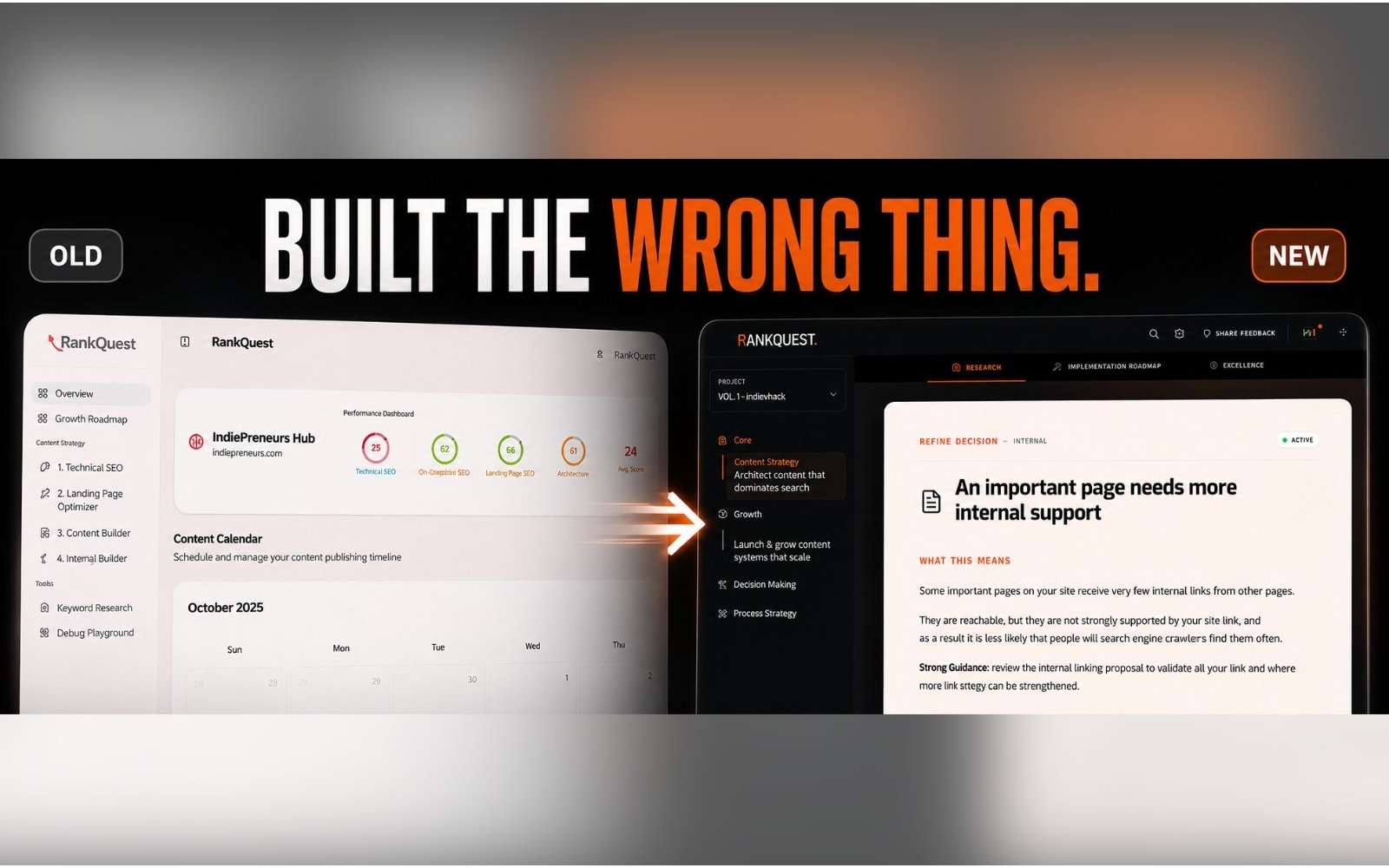
So RankQuest gradually moved away from the idea of being another all-in-one SEO dashboard.
Instead of asking:
“How much SEO information can I show?”
I started asking:
“What is the single most useful decision I can make for the user right now?”
That changed the product completely.
Today, RankQuest continuously observes the website and its search data, then selects one active SEO decision instead of dumping a huge list of issues on the user. It explains why that decision matters, shows the evidence behind it, and then gives the user a guided path to implement it. RankQuest
Once that work is done, the site gets checked again and the next decision can surface. RankQuest
That simple loop became the core of the product:
Observe → Decide → Implement → Re-check.
The hardest part was letting go of complexity
As a developer, adding features feels productive.
Removing them feels strangely uncomfortable.
You’ve already spent the time building something, so your instinct is to keep it.
But I eventually realized that complexity I was proud of as a builder could become friction for the user.
A dashboard with 100 SEO issues may look impressive.
But if the user closes it because they don’t know where to begin, it hasn’t really solved anything.
That became the biggest lesson from the pivot:
More information does not automatically create more clarity.
Sometimes the product becomes better when it makes fewer decisions available to the user, not more.
What RankQuest became
RankQuest now focuses much more on the decision layer of SEO.
It still uses real website, Search Console, performance, keyword, and SERP data, but the goal isn’t simply to display it. The goal is to turn those signals into the next meaningful action. RankQuest
The same thinking also shaped the rest of the product.
The Implementation Room exists around the current decision so the user can actually execute it, and the Growth Engine chooses focused content opportunities rather than producing an endless list of ideas. RankQuest
I’m still refining the idea, and I still question parts of it constantly.
But the pivot taught me something I keep coming back to while building:
Your users may not need more features. They may need you to make the hard decision for them.
And sometimes the best product improvement is not adding something new.
It’s deciding what can disappear.